
Cagrilintide
Explore the science, structure, and potential of today’s most studied research compounds.
Overview
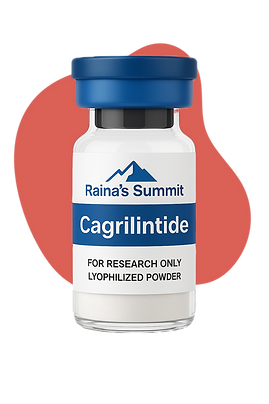
Cagrilintide is a long-acting, lipidated analog of the human hormone amylin, designed for once-weekly subcutaneous administration. It functions as a dual amylin and calcitonin receptor agonist (DACRA), modulating appetite and energy balance through central nervous system pathways.
Cagrilintide has demonstrated significant potential in weight management, both as a monotherapy and in combination with GLP-1 receptor agonists.
Potential Benefits
1. Weight Management
-
In a 26-week phase 2 trial, participants receiving 4.5 mg of Cagrilintide weekly experienced a mean weight loss of 10.8%, compared to 3.0% with placebo.
2. Combination Therapy (CagriSema)
-
Combining Cagrilintide with Semaglutide (CagriSema) has shown superior weight loss outcomes compared to either agent alone. In a 32-week study, the combination led to a mean weight reduction of 15.6%, versus 8.1% with Semaglutide alone.
3. Glycemic Control
-
While primarily investigated for weight management, Cagrilintide has also demonstrated modest improvements in glycemic parameters, including reductions in fasting plasma glucose and HbA1c levels.
Dosing and Titration
-
Route: Subcutaneous injection
-
Frequency: Once weekly
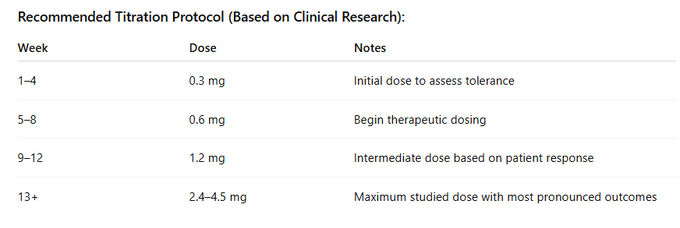
Recommended Titration Protocol (Based on Available Studies):
Gradual titration is critical to improving tolerability and minimizing gastrointestinal side effects.
-
Titration is essential to minimize gastrointestinal side effects and improve tolerability
Risks
This is not an exhaustive safety profile and reflects only publicly published, limited studies.
-
Gastrointestinal effects: Nausea, vomiting, and constipation are common, especially during dose escalation.
-
Hypoglycemia: Increased risk when combined with insulin or insulin secretagogues.
-
Injection site reactions: Redness, swelling, or discomfort at the injection site may occur.
-
Other: Potential for delayed gastric emptying and pancreatitis; patients should be monitored for symptoms.
References
-
Dutta D, Nagendra L, Harish BG, et al.
Efficacy and Safety of Cagrilintide Alone and in Combination with Semaglutide (CagriSema) as Anti-Obesity Medications: A Systematic Review and Meta-Analysis.
Indian J Endocrinol Metab. 2024;28(5):436–444.
https://www.ncbi.nlm.nih.gov/pmc/articles/PMC11642503/ -
Eržen S, Tonin G, Jurišić Eržen D, et al.
Amylin, Another Important Neuroendocrine Hormone for the Treatment of Diabesity.
Int J Mol Sci. 2024;25(3):1517.
https://www.ncbi.nlm.nih.gov/pmc/articles/PMC10855385/ -
D'Ascanio AM, Mullally JA, Frishman WH.
Cagrilintide: A Long-Acting Amylin Analog for the Treatment of Obesity.
Cardiol Rev. 2024;32(1):83–90.
https://pubmed.ncbi.nlm.nih.gov/36883831/ -
Frias JP, Deenadayalan S, Erichsen L, et al.
Efficacy and Safety of Co-Administered Once-Weekly Cagrilintide 2.4 mg with Once-Weekly Semaglutide 2.4 mg in Type 2 Diabetes: A Multicentre, Randomised, Double-Blind, Active-Controlled, Phase 2 Trial.
Lancet. 2023;402(10403):720-730.
https://www.ncbi.nlm.nih.gov/pmc/articles/PMC11760743/ -
Yacawych WT, Wang Y, Zhou G, et al.
A Cross-Species Atlas of the Dorsal Vagal Complex Reveals Neural Mediators of Cagrilintide's Effects on Energy Balance.
https://www.ncbi.nlm.nih.gov/pmc/articles/PMC11760743/